
Saturday, April 30, 2011
The Hitchcock Kiss
Recently on our Facebook page we discussed our favorite kisses in Hitchcock's films, and so here we have the Hitchcock Kiss, with a nod to Joel Gunz whose recent posts on hit Alfred Hitchcock Geek blog have pointed to the influence of sculptor Augusts Rodin on Hitchcock's work. Well worth your time to check out!


A Look Back at Some of Hitch's Collaborators I've Encountered
Thirty-one years go yesterday, Alfred Hitchcock passed away. I do not think he would be at all surprised to know that the mark he left on cinema and on pop culture continues and shows no signs of waning. Earlier this week I made a return appearance on The Radio Dan Show where regular guest Joel Gunz (you know him as Alfred Hitchcock Geek), host Dan Delgado, and the "super-hot" intern-extraordinaire (she likes me to call her that) Jessica Pac talk about all-things-Hitchcock in a segment of the show each Monday. You can listen in or view a video of the show here (the Hitchcock segment starts at about the 38 minute mark).
This week I was going to talk about some of the Hitchcock collaborators and associates I've encountered in my work. I'd planned to talk about Ernie Lehman, Evan Hunter, Doc Erickson, Henry Bumstead, Joseph Stefano, Herbert Coleman, and others. But as usual the clock wound down far too quickly and I only got to speak about the last two. Both of which I feel made significant contributions to Writing with Hitchcock —one because it was just part of his generous nature, and the other in spite of himself, as he admitted to a reluctance to provide me with anything worthwhile, and possibly had an ulterior motive in providing what he did.
Of course the former is Joseph Stefano, the screenwriter of Psycho , who I had the pleasure of meeting for the first time at NYU's Hitchcock Centennial Conference in 1999. To re-cap the story I told on Dan's show, I first saw Joe at the panel discussion of Hitchcock's screenwriters, which also included Evan Hunter and Arthur Laurents (unavailable at the time of this session, Jay Presson Allen had a one-on-one later in the conference). I had tried to get John Michael Hayes to be a part of this panel, but his vision had made travel difficult and he declined, saying that he'd be well represented by my presence and presentation. The discussion was entertaining and informative, but for the most part did not break much new ground for me. What was apparent though was that Joe was the most enthusiastic and unpretentious of the bunch. He engaged with the audience and seemed genuinely interested in the others' experiences with Hitch. On a personal level, I was impressed.
On another morning of the conference I was to present my work on Hayes's collaboration with Hitchcock. Right before the session began, way at the back I noticed Joseph Stefano and his wife Marilyn enter. I thought, "Wow, this is so cool of him. He's not just here to tell his own stories, toot his own horn, and revel in adulation." Joe was a true lover of film. He loved talking about it, doing it, engaging with new people who were also interested in it. Then when I saw he was making his way down to two empty seats right in the front row it occurred to me, here I was about to give a presentation of what it was like being a screenwriter for Hitchcock, when one of his screenwriters was sitting not more than ten feet from me!
Quickly while the moderator was busy with the introductions of my fellow panelists, I began sifting through my notes finding places to drop in Joe's name and some insightful, praiseworthy comments about his work on Psycho. At the end of the session Joe and Marilyn Stefano introduced themselves and congratulated me. Joe said I'd nailed it, that Hayes's experience felt very similar to his own, and that we should stay in touch. Of course we did, and he provided some great material for Writing with Hitchcock, not the least of which was his very kind endorsement after reading the galleys:
Part II tomorrow...Herbert Coleman.
 |
| Joseph Stefano, screenwriter of Psycho and the first writer engaged to write Marnie. |
—one because it was just part of his generous nature, and the other in spite of himself, as he admitted to a reluctance to provide me with anything worthwhile, and possibly had an ulterior motive in providing what he did.Of course the former is Joseph Stefano, the screenwriter of Psycho
, who I had the pleasure of meeting for the first time at NYU's Hitchcock Centennial Conference in 1999. To re-cap the story I told on Dan's show, I first saw Joe at the panel discussion of Hitchcock's screenwriters, which also included Evan Hunter and Arthur Laurents (unavailable at the time of this session, Jay Presson Allen had a one-on-one later in the conference). I had tried to get John Michael Hayes to be a part of this panel, but his vision had made travel difficult and he declined, saying that he'd be well represented by my presence and presentation. The discussion was entertaining and informative, but for the most part did not break much new ground for me. What was apparent though was that Joe was the most enthusiastic and unpretentious of the bunch. He engaged with the audience and seemed genuinely interested in the others' experiences with Hitch. On a personal level, I was impressed. On another morning of the conference I was to present my work on Hayes's collaboration with Hitchcock. Right before the session began, way at the back I noticed Joseph Stefano and his wife Marilyn enter. I thought, "Wow, this is so cool of him. He's not just here to tell his own stories, toot his own horn, and revel in adulation." Joe was a true lover of film. He loved talking about it, doing it, engaging with new people who were also interested in it. Then when I saw he was making his way down to two empty seats right in the front row it occurred to me, here I was about to give a presentation of what it was like being a screenwriter for Hitchcock, when one of his screenwriters was sitting not more than ten feet from me!
Quickly while the moderator was busy with the introductions of my fellow panelists, I began sifting through my notes finding places to drop in Joe's name and some insightful, praiseworthy comments about his work on Psycho
. At the end of the session Joe and Marilyn Stefano introduced themselves and congratulated me. Joe said I'd nailed it, that Hayes's experience felt very similar to his own, and that we should stay in touch. Of course we did, and he provided some great material for Writing with Hitchcock, not the least of which was his very kind endorsement after reading the galleys: "With diamond clarity, Steven DeRosa defines the art, the joy, the rewards—and the hazards—of screenwriting for a cinematic genius like Alfred Hitchcock."
—Joseph Stefano, Screenwriter of Psycho
Thursday, February 10, 2011
In response to news of a proposed remake of Hitchcock’s The Man Who Knew Too Much
I can hear the pitch now … why remake when we can make it a sequel?
It’s 2012…and Hank Conway…um, I mean McKenna, now in his mid-60s has arrived in Washington DC to attend the Kennedy Center Honors which is being awarded posthumously to his mother Jo the following evening. After checking into his hotel suite, he telephones his daughter Joanna who is traveling by train to meet him. Joanna has a fear of flying and hasn’t been quite right since the divorce. She travels with her 7 year old son, Ben. Hank tells Joanna he’ll pick them up at the station in the morning.
That night, as the train makes its way toward the nation’s capital, curious little Ben wanders to the empty observation car while his mother sleeps one off. Three foreign speaking men enter and Ben overhears their conversation. Parts of it in English lead him to believe they’re going to murder somebody. Inadvertently, Ben makes a sound and the men know someone is in the car with them.
When Ben goes back to find his mother, she’s vanished! The waiter, the conductors, the other passengers, have no recollection of her being there.
In the morning, Ben arrives to find his grandfather waiting on the platform…as Hank begins to ask where Ben’s mom is, his cell phone rings…
They’re holding Joanna… and she’ll be freed as long as young Ben keeps his trap shut. But being his father’s son, Hank isn’t about to let that stop he and his grandson from recovering Joanna. The action all leads to the Kennedy Center where one of the foreign men is going to assassinate the President of the United States just as Lady Gaga belts out "Whatever Will Be" during a medley of Jo's greatest hits.
Hey, you never know. But seriously, if you guys want to use this....ring my agent.
Monday, January 17, 2011
Hitchcock Locations Photo Contest
It's that time again! We're having another contest. This time your assignment is to put yourself in L.B. Jefferies's shoes, grab your trusty camera, and snap some shots of Hitchcock locations. I'm hoping we get some totally unexpected entries. Happy hunting!
Visit our Facebook Page for details!

Tuesday, January 11, 2011
To Catch a Thief comes to the radio in new adapation
In case you missed last  Saturday's BBC 4 broadcast of To Catch a Thief(which will be online until 1/15/2011), here's my brief review.
Naturally, as I cover the writing and production of To Catch a Thief in great detail in Writing with Hitchcock (in addition to the novel's origins), I listened to the BBC 4 broadcast with a great familiarity to David Dodge’s novel and with a keen ear to pick up any references to the film or to see if the writer of this new adaptation, Jean Buchanan, opted to forget the film entirely.
Choosing the latter, Buchanan was fairly faithful to Dodge, judiciously pruning where necessary—eliminating, as Hitchcock and Hayes did, a second copy-cat thief—while keeping the subplot with Robie’s old friend Paul du Pré…which is oddly reminiscent of certain aspects of Vertigo , based on a French novel Hitchcock would purchase the rights to not long after To Catch a Thief was released.
As pointed out in Elisabeth Mahoney’s review on guardian.co.uk, the slivers of description for the characters highlighted the differences between this version and Hitchcock’s film. Can one imagine Cary Grant padding himself another ten or twenty pounds, shaving back his hairline so that he appears to be balding, and then having to make love to Grace Kelly? In Hitchcock’s cinema, that just wouldn’t fly.
As entertaining as Hitchcock’s film is, its main flaw is the villain. In all three the actual copy-cat thief is Danielle, but Hitchcock and John Michael Hayes opted to make Bellini (Bertani in the final film) the mastermind behind the jewel robberies. The only problem was Hitchcock cast French actor Charles Vanel in the role without knowing he did not speak English at all. Choosing to have Hayes rewrite and rewrite again, rather than recast, the role was severely watered down along with the suspense. In Dodge’s novel and this radio adaptation, Bellini seems to have his hand in every shady business along the Riviera, so one comes away with the sense that he’s somehow profiting from the robberies anyway. In that respect, Bellini (although not the villain) is more richly drawn here than by Hitchcock.
Hitchcock’s To Catch a Thief has always been known best for its sophisticated dialogue and double entendres—penned by the radio-trained Hayes. So the one disappointment in this adaptation is that Buchanan stuck too closely to Dodge’s own dialogue, which fell somewhat flat—a shame since a radio drama relies heavily on dialogue. I’m not suggesting that “borrowing” from John Michael Hayes was necessary, but perhaps taking a bit of inspiration from him would have lifted the material and the performances at the same time.
Overall, very entertaining and a nice way to remind audiences that Hitchcock’s films were not solely the result of his creative genius.
Saturday's BBC 4 broadcast of To Catch a Thief(which will be online until 1/15/2011), here's my brief review.Naturally, as I cover the writing and production of To Catch a Thief
in great detail in Writing with Hitchcock (in addition to the novel's origins), I listened to the BBC 4 broadcast with a great familiarity to David Dodge’s novel and with a keen ear to pick up any references to the film or to see if the writer of this new adaptation, Jean Buchanan, opted to forget the film entirely. Choosing the latter, Buchanan was fairly faithful to Dodge, judiciously pruning where necessary—eliminating, as Hitchcock and Hayes did, a second copy-cat thief—while keeping the subplot with Robie’s old friend Paul du Pré…which is oddly reminiscent of certain aspects of Vertigo
, based on a French novel Hitchcock would purchase the rights to not long after To Catch a Thief was released. As pointed out in Elisabeth Mahoney’s review on guardian.co.uk, the slivers of description for the characters highlighted the differences between this version and Hitchcock’s film. Can one imagine Cary Grant padding himself another ten or twenty pounds, shaving back his hairline so that he appears to be balding, and then having to make love to Grace Kelly? In Hitchcock’s cinema, that just wouldn’t fly.
As entertaining as Hitchcock’s film is, its main flaw is the villain. In all three the actual copy-cat thief is Danielle, but Hitchcock and John Michael Hayes opted to make Bellini (Bertani in the final film) the mastermind behind the jewel robberies. The only problem was Hitchcock cast French actor Charles Vanel in the role without knowing he did not speak English at all. Choosing to have Hayes rewrite and rewrite again, rather than recast, the role was severely watered down along with the suspense. In Dodge’s novel and this radio adaptation, Bellini seems to have his hand in every shady business along the Riviera, so one comes away with the sense that he’s somehow profiting from the robberies anyway. In that respect, Bellini (although not the villain) is more richly drawn here than by Hitchcock.
Hitchcock’s To Catch a Thief
has always been known best for its sophisticated dialogue and double entendres—penned by the radio-trained Hayes. So the one disappointment in this adaptation is that Buchanan stuck too closely to Dodge’s own dialogue, which fell somewhat flat—a shame since a radio drama relies heavily on dialogue. I’m not suggesting that “borrowing” from John Michael Hayes was necessary, but perhaps taking a bit of inspiration from him would have lifted the material and the performances at the same time.Overall, very entertaining and a nice way to remind audiences that Hitchcock’s films were not solely the result of his creative genius.
Saturday, December 25, 2010
Alfred Hitchcock's Favorite Crime: The Case of Dr. Crippen
A Christmas treat courtesy of hulu.com...the Alfred Hitchcock directed episode of Alfred Hitchcock Presents, Back for Christmas, followed by a little background on Hitchcock's favorite crime. Enjoy!
That Alfred Hitchcock possessed one of the most complete collections of literature relating to true crime is a well-known fact. Frequently elements from the most notorious criminal cases found their way into Hitchcock’s films. The case of Jack-the-Ripper was the inspiration for The Lodger ; the Siege of Sidney Street made its way into The Man Who Knew Too Much
 (1934); the trial of William Palmer influenced Suspicion; the manner in which Patrick Mahon disposed of his victim’s remains became part of Rear Window
 ; the crimes of Ed Gein inspired Psycho. Perhaps the case which Hitchcock referred to most often for inspiration was the case of Dr. Hawley Harvey Crippen.
The facts of the case are simple enough: Dr. Crippen poisoned his wife, Cora, by giving her a lethal dose of hyoscin. He then cut up the corpse, burned and buried the remains in the basement of his home, and went about concealing his crime by writing several letters to his wife’s friends explaining that she had gone to America. During the next few months, Dr. Crippen pawned several pieces of his wife’s jewelry, and was frequently seen in the company of his mistress, Ethel Le Neve. When the police became suspicious, Crippen left his home, prompting a thorough search of the house, where human remains were discovered beneath the bricks of the coal cellar. Within days, Crippen and Le Neve, boarded the S.S. Montrose for America, disguised as father and son, but were quickly found out by the ship’s captain who sent a wireless message back to England, indicating that the fugitives were passengers on his ship. Detectives boarded another ship which intercepted the Montrose, and the pair were arrested at sea. After a trial which lasted five days, Crippen was found guilty and sentenced to death, and executed one month later.
Filson Young, who edited the volume The Trial of H. H. Crippen for the series Notable British Trials, noted that the case was extraordinary not so much from a legal point of view, but that its fascination came from its central figures. There are several theories as to why Crippen murdered his wife. The official theory of the prosecution was that Crippen murdered his wife so that he could be with Ethel Le Neve. Another theory had it that Dr. Crippen could not satisfy his wife’s sexual appetite, and sought to depress her sexual drive by giving her a dose of hydrobromide of hyoscin (which at the time was used to treat extreme cases of sexual addiction). Crippen administered 5 grains of hyoscin to his wife in a cup of coffee, and to his horror, she died. Fearing no one would accept his explanation, he cut up, burned, and disposed of his wife’s remains and went about explaining her disappearance as he did.
Young dismisses these theories however in light of the facts of the case. Young’s theory is that on several occasions Cora Crippen had threatened to leave her husband if he did not give up his association with Ethel Le Neve, and that she would take all her money (and jewelry) with her. It was this threat that sealed Cora Crippen’s fate.
Aspects of the case recur in Hitchcock’s work on both the big and small screen. The example cited most often by Hitchcock was in Rear Window, where the plot was constructed so that the chief piece of evidence incriminating the murderer, Lars Thorwald, was the jewelry left behind by his late wife, particularly her wedding ring. The incriminating jewelry idea was used again by Hitchcock in Vertigo, as Judy Barton adorns the necklace that had once belonged to Carlotta Valdes which was inherited by the real Madeline Elster.
Hitchcock was not the only artist who saw the dramatic possibilities of the Crippen case. Francis Isles (pseudonym of Anthony Berkely Cox) based his 1931 novel Malice Aforethought on the Crippen case. Hitchcock had filmed Isles’s Before the Fact
 as Suspicion
  in 1941 for RKO, and later directed a radio production of Malice Aforethought in 1945. Hitchcock wanted to make a film out of Malice Aforethought, and even announced it as a possibility for his own production company Transatlantic Pictures in 1953. Alec Guinness was the director’s choice for the role of the murderous Dr. Bickleigh, but as the actor was unavailable and Hitchcock moved from Warner Brothers to Paramount later that year, the project was never seriously developed.
Another aspect of the case influenced Frederick Knott’s play Dial M for Murder . In his statement to the police, Dr. Crippen explained that for a period of eight months he went to America on business, and his wife remained in England. During her husband’s absence, Cora Crippen had begun singing at smoking concerts, and was receiving attention from an American music hall artist named Bruce Miller. Crippen stated, “I never saw the man Bruce Miller, but he used to call when I was out, and used to take her out in the evenings ... I did not think anything of Bruce Miller’s visiting my wife at the time ... I have seen letters from Bruce to her, which ended ‘with love and kisses to Brown Eyes.’” At trial, Bruce Miller denied that he and Mrs. Crippen had ever been lovers, and stated that his letters were not ‘love letters’, but ‘affectionate letters.’ In Dial M for Murder, it is a love letter from Mark Halliday (Max in the play) to Margot Wendice which brings about Tony Wendice’s murderous intentions.
The closest Hitchcock came to making a film directly influenced by the Crippen case was an episode of Alfred Hitchcock Presents called Back for Christmas. In this episode, Herbert Carpenter, played by Hitchcock favorite John Williams (The Paradine Case , Dial M for Murder, To Catch a Thief), kills his wife Hermione on the eve of their prolonged trip to America. Herbert buries his wife in the basement of their house, where he had been digging a hole for the installation of a wine cellar. He then goes to California alone, and is enjoying life as a bachelor. Early on, Hermione insisted to her friends (over her husband’s objections) that they’d be “back for Christmas.” To cover his tracks, Herbert writes letters to Hermione’s friends, just as Dr. Crippen did, indicating they have decided not to return to England. But Herbert’s undoing comes when he receives a bill from an excavation company engaged by his wife to complete the wine cellar during their absence, insisting that the work be completed before Christmas. It seems Hermione was right, after all.
That Alfred Hitchcock possessed one of the most complete collections of literature relating to true crime is a well-known fact. Frequently elements from the most notorious criminal cases found their way into Hitchcock’s films. The case of Jack-the-Ripper was the inspiration for The Lodger
; the Siege of Sidney Street made its way into The Man Who Knew Too Much (1934); the trial of William Palmer influenced Suspicion; the manner in which Patrick Mahon disposed of his victim’s remains became part of Rear Window; the crimes of Ed Gein inspired Psycho. Perhaps the case which Hitchcock referred to most often for inspiration was the case of Dr. Hawley Harvey Crippen. The facts of the case are simple enough: Dr. Crippen poisoned his wife, Cora, by giving her a lethal dose of hyoscin. He then cut up the corpse, burned and buried the remains in the basement of his home, and went about concealing his crime by writing several letters to his wife’s friends explaining that she had gone to America. During the next few months, Dr. Crippen pawned several pieces of his wife’s jewelry, and was frequently seen in the company of his mistress, Ethel Le Neve. When the police became suspicious, Crippen left his home, prompting a thorough search of the house, where human remains were discovered beneath the bricks of the coal cellar. Within days, Crippen and Le Neve, boarded the S.S. Montrose for America, disguised as father and son, but were quickly found out by the ship’s captain who sent a wireless message back to England, indicating that the fugitives were passengers on his ship. Detectives boarded another ship which intercepted the Montrose, and the pair were arrested at sea. After a trial which lasted five days, Crippen was found guilty and sentenced to death, and executed one month later.
Filson Young, who edited the volume The Trial of H. H. Crippen for the series Notable British Trials, noted that the case was extraordinary not so much from a legal point of view, but that its fascination came from its central figures. There are several theories as to why Crippen murdered his wife. The official theory of the prosecution was that Crippen murdered his wife so that he could be with Ethel Le Neve. Another theory had it that Dr. Crippen could not satisfy his wife’s sexual appetite, and sought to depress her sexual drive by giving her a dose of hydrobromide of hyoscin (which at the time was used to treat extreme cases of sexual addiction). Crippen administered 5 grains of hyoscin to his wife in a cup of coffee, and to his horror, she died. Fearing no one would accept his explanation, he cut up, burned, and disposed of his wife’s remains and went about explaining her disappearance as he did.
Young dismisses these theories however in light of the facts of the case. Young’s theory is that on several occasions Cora Crippen had threatened to leave her husband if he did not give up his association with Ethel Le Neve, and that she would take all her money (and jewelry) with her. It was this threat that sealed Cora Crippen’s fate.
Aspects of the case recur in Hitchcock’s work on both the big and small screen. The example cited most often by Hitchcock was in Rear Window
, where the plot was constructed so that the chief piece of evidence incriminating the murderer, Lars Thorwald, was the jewelry left behind by his late wife, particularly her wedding ring. The incriminating jewelry idea was used again by Hitchcock in Vertigo, as Judy Barton adorns the necklace that had once belonged to Carlotta Valdes which was inherited by the real Madeline Elster.Hitchcock was not the only artist who saw the dramatic possibilities of the Crippen case. Francis Isles (pseudonym of Anthony Berkely Cox) based his 1931 novel Malice Aforethought
on the Crippen case. Hitchcock had filmed Isles’s Before the Fact as Suspicion in 1941 for RKO, and later directed a radio production of Malice Aforethought in 1945. Hitchcock wanted to make a film out of Malice Aforethought, and even announced it as a possibility for his own production company Transatlantic Pictures in 1953. Alec Guinness was the director’s choice for the role of the murderous Dr. Bickleigh, but as the actor was unavailable and Hitchcock moved from Warner Brothers to Paramount later that year, the project was never seriously developed. Another aspect of the case influenced Frederick Knott’s play Dial M for Murder
. In his statement to the police, Dr. Crippen explained that for a period of eight months he went to America on business, and his wife remained in England. During her husband’s absence, Cora Crippen had begun singing at smoking concerts, and was receiving attention from an American music hall artist named Bruce Miller. Crippen stated, “I never saw the man Bruce Miller, but he used to call when I was out, and used to take her out in the evenings ... I did not think anything of Bruce Miller’s visiting my wife at the time ... I have seen letters from Bruce to her, which ended ‘with love and kisses to Brown Eyes.’” At trial, Bruce Miller denied that he and Mrs. Crippen had ever been lovers, and stated that his letters were not ‘love letters’, but ‘affectionate letters.’ In Dial M for Murder, it is a love letter from Mark Halliday (Max in the play) to Margot Wendice which brings about Tony Wendice’s murderous intentions.The closest Hitchcock came to making a film directly influenced by the Crippen case was an episode of Alfred Hitchcock Presents called Back for Christmas. In this episode, Herbert Carpenter, played by Hitchcock favorite John Williams (The Paradine Case
, Dial M for Murder, To Catch a Thief), kills his wife Hermione on the eve of their prolonged trip to America. Herbert buries his wife in the basement of their house, where he had been digging a hole for the installation of a wine cellar. He then goes to California alone, and is enjoying life as a bachelor. Early on, Hermione insisted to her friends (over her husband’s objections) that they’d be “back for Christmas.” To cover his tracks, Herbert writes letters to Hermione’s friends, just as Dr. Crippen did, indicating they have decided not to return to England. But Herbert’s undoing comes when he receives a bill from an excavation company engaged by his wife to complete the wine cellar during their absence, insisting that the work be completed before Christmas. It seems Hermione was right, after all.
Friday, December 17, 2010
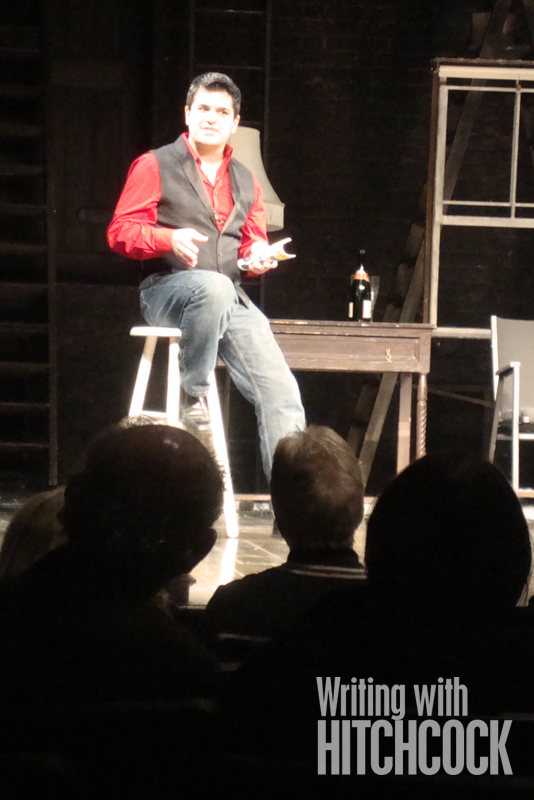
Talkback with the New York cast of The 39 Steps
I had a great time this week hosting a Talkback with the cast of The 39 Steps
 at the New World Stages in New York. If you haven't seen the show yet, hurry and catch it. This production closes January 16, 2011.
 |
| Steven DeRosa moderating Talkback with the New York cast of THE 39 STEPS (John Behlmann, Kate MacCluggage, Cameron Folmar, and unseen to the right, Jamie Jackson). |
The video quality is more than a bit lackluster (mostly poor audio but there are captions), but gives you an idea of what I spoke about with the cast—John Behlmann (Richard Hannay), Kate MacCluggage (Annabella/Pamela/Margaret), Jamie Jackson (Man #1), and Cameron Folmar (Man #2). We covered everything from Hitchcock's working methods with his writers, to the MacGuffin, to his typical means of adapting source material such as John Buchan's novel The Thirty-nine Steps
 , how the idea for transforming the film into a broad stage comedy for four actors came about, the actors' process of "finding their clown" within the various roles they play in the show, and much more.
 |
| "I'd say they do REAR WINDOW next, but the producers of DISTURBIA would probably sue." |
Subscribe to:
Posts (Atom)


 Posts
Posts

